
Focused on the transition from IMT-level answers to registrar-level interview performance.

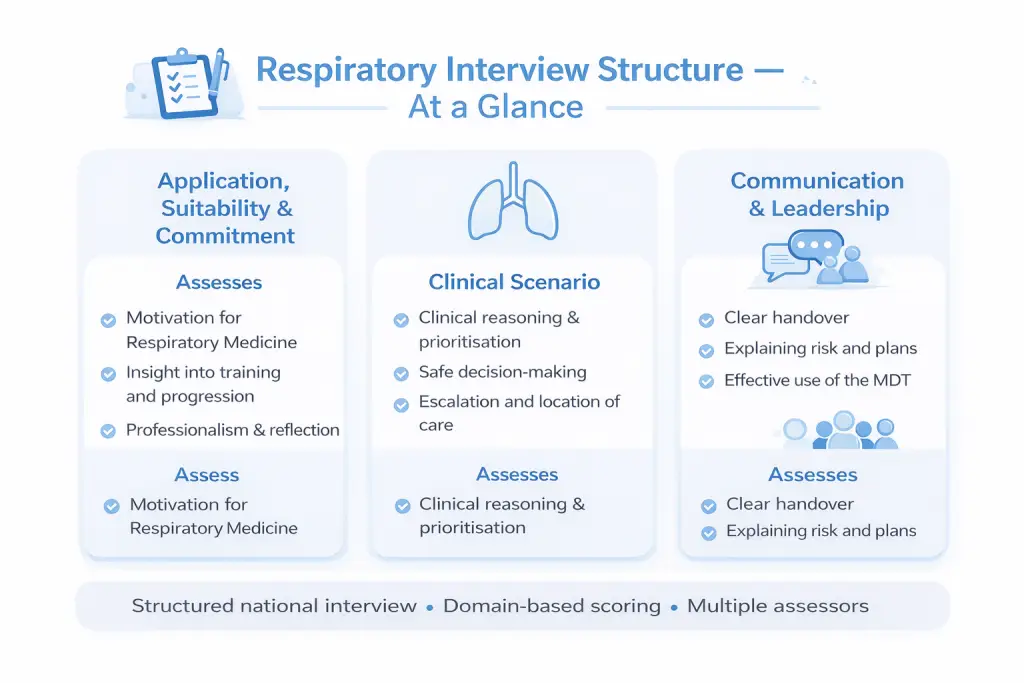
Interview performance is not judged on overall impression, but on how effectively candidates structure answers, communicate insight and judgement, and demonstrate readiness to work at Respiratory registrar level. Small differences in prioritisation, escalation, and clarity can therefore have a meaningful impact on overall scores.
This component assesses your overall suitability for Respiratory specialty training, including readiness to take on the responsibilities of a medical registrar.
Candidates are expected to demonstrate safe judgement, professionalism, and insight into the challenges of medical registrar on-call work, alongside an understanding of the broader role of a Respiratory registrar within acute and outpatient services.
This section explores your motivation for Respiratory Medicine and the evidence supporting that commitment
Candidates are expected to demonstrate clear evidence of commitment to the specialty, including sustained exposure to Respiratory clinics, procedural development and logbook progression, and engagement with relevant specialty-specific courses. Interviewers are looking for how these experiences translate into readiness for Respiratory registrar training, rather than a simple list of activities.
This station assesses clinical reasoning through a Respiratory-focused clinical scenario, often involving acute, unstable, or time-critical presentations. Candidates are expected to demonstrate safe decision-making, prioritisation, and escalation, including appropriate location of care and early senior involvement.
Scenarios commonly require the application of current guideline-based management (for example, current NICE guidance in asthma.), alongside recognition of important negative findings, red flags, and exclusions that influence escalation and risk. Interviewers are assessing registrar-level thinking, including the ability to recognise thresholds for intervention, anticipate deterioration, and articulate clear escalation plans rather than simply listing investigations or treatments.
As part of the clinical scenario, candidates may be asked to deliver a structured patient handover. This assesses prioritisation, clarity, and the ability to communicate risk, uncertainty, and management plans safely.
High-scoring handovers reflect medical registrar on-call practice, using a clear structure to highlight what matters now, important negatives, escalation plans, and what may go wrong next.
Understand how the Respiratory ST4 interview is structured, how candidates are assessed, and what interviewers are looking for in registrar-level responses
Our resources are informed by clinicians involved in recruitment and use AI to systematically map answers to interview scoring domains — rather than relying on anecdotal notes from previous candidates.
Our resources are informed by clinicians involved in recruitment and use AI to systematically map answers to interview scoring domains — rather than relying on anecdotal notes from previous candidates.