
Focused on the transition from IMT-level answers to registrar-level interview performance.

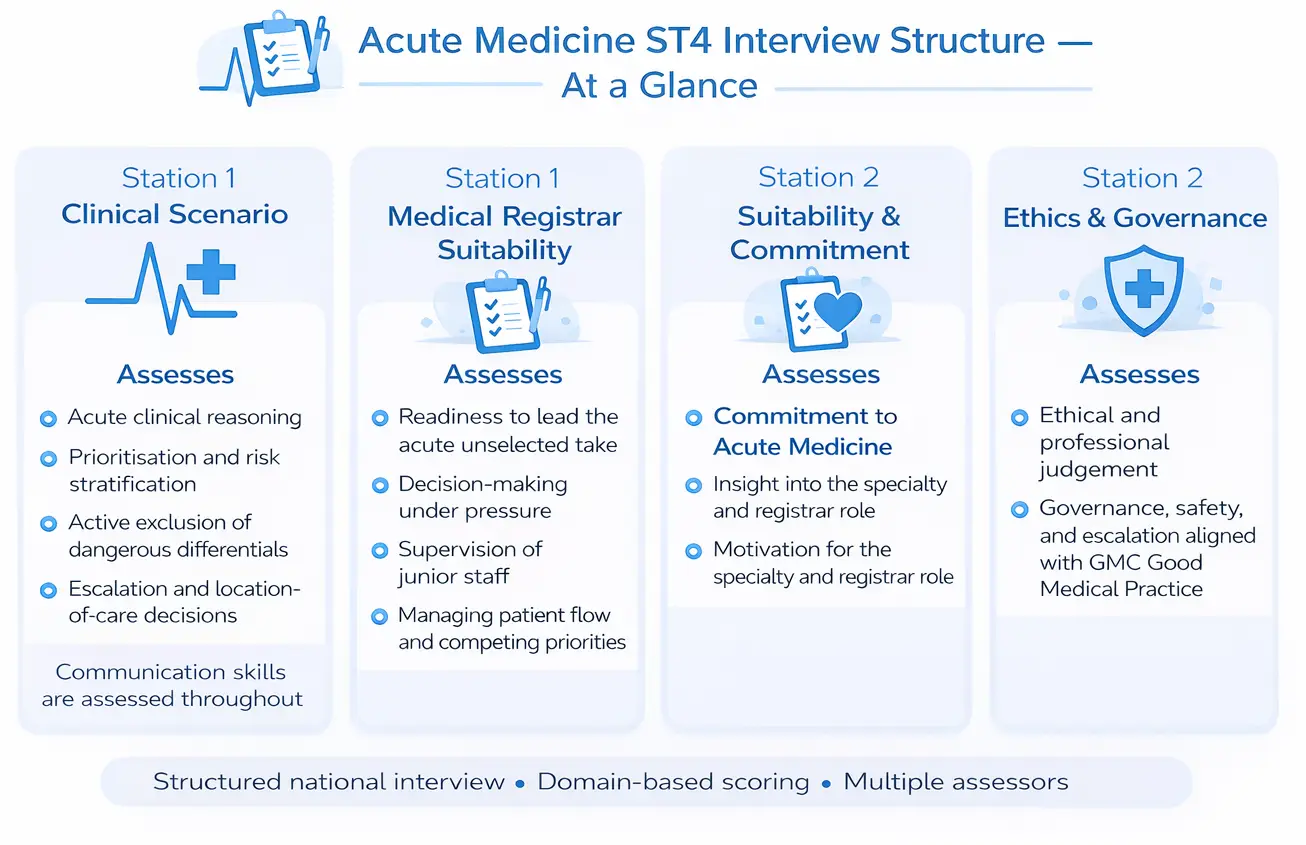
The Acute Medicine ST4 interview uses a structured national scoring system, with each station marked independently by trained interviewers. Candidates are assessed across defined domains using a 1–5 scoring scale, and marks are awarded only for what is clearly demonstrated during the interview.
Each station contributes a different weighting to the overall interview score. The interview itself is scored out of 50, which then contributes 80% of the total overall mark, with the remaining 20% derived from the application portfolio.
The interview is typically delivered virtually, and performance is judged not on overall impression, but on how effectively candidates prioritise, structure answers, communicate judgement, and demonstrate readiness for the medical registrar role. Small differences in clarity, escalation, and risk awareness can therefore have a meaningful impact on overall scores.
This part of the station explores how candidates approach non-technical challenges relevant to surgical training. Scenarios may involve patient safety concerns, professionalism, ethical dilemmas, service pressures, or working within a multidisciplinary team.
Assessors are looking for sound judgement, prioritisation, and appropriate escalation, rather than a single “correct” answer. Clear reasoning, proportional decision-making, and awareness of limitations are central to high-scoring responses.
Our interview preparation resources provide structured answer frameworks and realistic practice scenarios with marking guidance, designed to help candidates refine management answers from competent, safe responses to those that consistently meet the highest scoring criteria.
This component assesses your suitability to work as a medical registrar on the acute unselected take, including readiness to take on responsibility for clinical decision-making, team leadership, and patient flow.
Candidates are expected to demonstrate safe judgement, professionalism, and insight into the realities of acute medical registrar work — including managing uncertainty, supervising junior colleagues, maintaining patient flow, and making timely escalation decisions in high-pressure environments.
This component assesses clinical reasoning through an acute, undifferentiated medical scenario, reflecting presentations commonly encountered on the acute unselected take, AMU, or SDEC.
Candidates are expected to demonstrate safe decision-making, prioritisation, and escalation, including appropriate initial assessment, early management, and clear decisions about location of care and senior involvement.
Scenarios are typically brief and time-pressured, requiring candidates to structure their thinking clearly. Interviewers are assessing registrar-level judgement, including the ability to actively consider and rule out important alternative diagnoses, identify red flags and important negative findings, anticipate deterioration, and articulate clear escalation and contingency plans — rather than simply arriving at a single “correct” diagnosis or listing investigations and treatments.
This section explores your motivation for Respiratory Medicine and the evidence supporting that commitment
Candidates are expected to demonstrate clear evidence of commitment to the specialty, including sustained exposure to Respiratory clinics, procedural development and logbook progression, and engagement with relevant specialty-specific courses. Interviewers are looking for how these experiences translate into readiness for Respiratory registrar training, rather than a simple list of activities.
This component assesses professional judgement through a non-clinical ethical or governance scenario, grounded in GMC Good Medical Practice.
Scenarios commonly involve concerns about a colleague, managing mistakes or incidents, and confidentiality or consent dilemmas — such as a family requesting information when a patient has not given permission.
Candidates are expected to prioritise patient safety, demonstrate appropriate professional boundaries, and recognise when to escalate concerns. High-scoring responses show clear reasoning, proportionate decision-making, and insight into professional responsibility, rather than detailed policy knowledge.
Our resources are informed by clinicians involved in recruitment and use AI to systematically map answers to interview scoring domains — rather than relying on anecdotal notes from previous candidates.
Our resources are informed by clinicians involved in recruitment and use AI to systematically map answers to interview scoring domains — rather than relying on anecdotal notes from previous candidates.